Summary
US lawmakers told the House Foreign Affairs Committee that China is exploiting its UN peacekeeping role to gather intelligence in strategically sensitive regions aligned with its global military and economic ambitions.
What Happened
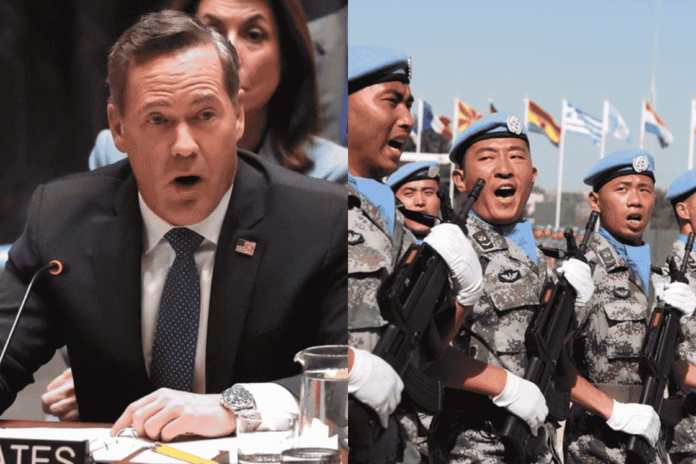
At a House Foreign Affairs Committee hearing in Washington on Wednesday, US lawmakers accused China of using its United Nations peacekeeping missions as a cover for espionage. Republican Congresswoman Sheri Biggs told the committee that Chinese peacekeeping deployments are concentrated in areas aligned with Belt and Road Initiative corridors, near ports, mineral resources, and locations of potential military interest.
US Ambassador to the UN Mike Waltz told the committee that while Chinese peacekeeping forces are generally well-prepared, “I don’t think for a second that they don’t serve a dual purpose as eyes and ears on the ground for the Chinese Communist Party.”
What Does Concentration in Strategic Places Mean
When Biggs described Chinese peacekeeping deployments as concentrated in strategically sensitive regions, she was pointing to a pattern that goes beyond coincidence. The Belt and Road Initiative has given China deep economic footholds across Africa, Central Asia, and parts of the Middle East, often in countries rich in minerals, with deep water ports, or positioned along critical maritime and overland trade routes.
Peacekeeping missions in these regions give Chinese military personnel legal, sanctioned access to territory that would otherwise require espionage to penetrate.
The reference to South Sudan is particularly telling. China has major energy investments there, and Waltz specifically mentioned the US reform push to downsize the UN mission in that country. A smaller mission means fewer Chinese boots on the ground in an area Beijing considers economically and strategically vital.
Has the United States Done This Before
Intelligence activities conducted through or alongside the UN are not unique to China, and the United States has its own documented history in this area.
The clearest case involved the UN Special Commission on Iraq in the 1990s. US intelligence services secretly embedded agents within UNSCOM inspection teams and installed equipment including cameras, sensors, and signal repeaters during weapons inspections. The operation went beyond the stated disarmament mandate, collecting broader Iraqi military communications and signals intelligence to support American military planning. UNSCOM leadership was not fully informed or authorized the operation.
A second instance emerged in 2010 when WikiLeaks published US diplomatic cables revealing State Department directives signed under Secretary Hillary Clinton. American diplomats were instructed to collect detailed intelligence on UN officials, including Secretary General Ban Ki-moon, and foreign delegations. The targets included biometric data, encryption keys, passwords, travel schedules, and negotiating positions.
These cases do not cancel out the concerns raised about China, but they establish an important context. Exploiting multilateral institutions for intelligence gain is a practice with precedent among the world’s major powers, not an innovation unique to Beijing.