

There is a footbridge in a quiet park in Vienna, Virginia, about twelve miles outside Washington D.C. On the surface it is unremarkable. Locals walk their dogs there. Children play nearby. But on the night of February 18, 2001, FBI surveillance teams watched as a senior FBI agent crouched beneath that bridge and placed a package of highly classified documents for his Russian handlers. That agent was Robert Hanssen. He had been doing exactly this, at this exact location and others like it, for over two decades.
He was arrested that night at the dead drop site he had used for years.
The dead drop is one of the oldest and most psychologically sophisticated techniques in the history of espionage. It has outlasted empires, survived the digital revolution, and continues to be used by intelligence services, criminals, whistleblowers, and activists around the world. Understanding it properly means understanding something fundamental about how espionage actually works, not the Hollywood version, but the real operational logic that has kept agents alive and governments informed for centuries.
This guide covers everything. The history, the mechanics, the psychology, the famous cases, and where the technique stands today.
What is a Dead Drop?
A dead drop, also called a dead letter box or DLB, is a method of exchanging items, documents, money, or data between two parties without them ever meeting in person or even being in the same location at the same time.
One party leaves something at a prearranged location. The other party collects it later. The exchange happens through the location rather than between the people. At no point do the two individuals involved need to see each other, acknowledge each other, or even know where the other person is at any given moment.
That is the entire concept. The genius, as we will see, is not in the simplicity of the method but in the operational security architecture built around it.
A dead drop is different from a live drop, which involves a direct hand-to-hand exchange between two people, sometimes called a brush pass. It is also different from a brush contact, where two people make brief physical contact in public to exchange something. The dead drop eliminates human contact from the equation entirely, and that elimination is the point.
The Operational Logic Behind It
To understand why the dead drop exists, you need to understand the fundamental problem it solves.
When a spy meets their handler in person, both individuals are exposed simultaneously. If surveillance is following either one of them, that meeting can compromise both. If one of them is already under investigation, the meeting hands investigators a direct link between the two. A single observed meeting can unravel years of careful work and destroy an entire network.
The dead drop solves this by separating the two parties in time and space. The spy visits the location and leaves the material. Hours or days later the handler visits the same location and collects it. Two visits to the same park bench by two different people on two different days looks like nothing. It is nothing, from the outside.
This is what intelligence professionals call compartmentalisation in action. Even if the spy is under surveillance during their visit to the dead drop location, all investigators see is someone taking a walk. Even if the handler is identified, there is no direct observed connection between the two. The location is the intermediary. The location cannot talk.
There is a second layer of operational logic that is less obvious but equally important. If one party is captured and interrogated, they can only reveal the location of the drop and the signal system. They cannot describe meetings they never had, identify a face they never saw clearly, or confirm a relationship that was never made explicit. The dead drop protects both parties from each other as much as it protects them from outside surveillance.
Who Uses Them and Why
Dead drops are not exclusively a tool of state intelligence agencies, though that is where the technique was most thoroughly developed and refined.
State intelligence services use dead drops for running human assets, passing tasking instructions to agents in the field, delivering payment, and receiving collected intelligence. The KGB, CIA, MI6, Mossad, and virtually every major intelligence service in the world has used them operationally.
Resistance and insurgent networks have relied on dead drops throughout history, particularly in environments where members of a network must be kept isolated from each other to prevent a single arrest from compromising the whole organisation. During World War Two, resistance fighters across occupied Europe used dead drop techniques to pass intelligence to Allied networks without creating direct personal connections that could be extracted under interrogation.
Whistleblowers and journalists use versions of the same principle. SecureDrop, the encrypted submission platform used by major news organisations to receive anonymous tips, is a digital evolution of the dead drop concept. A source leaves information at a location. A journalist retrieves it. They never need to meet.
Criminals and drug trafficking networks use dead drops to separate the financial and logistical chains of their operations, ensuring that couriers who are arrested cannot identify the people above them in the network.
The common thread across all of these users is the same: the dead drop exists wherever the cost of direct human contact is too high.
A Brief History
The dead drop is far older than the Cold War. The operational principle appears in ancient history wherever secret communication was necessary between parties who could not safely meet.
In Tsarist Russia, revolutionary networks used dead letter systems to communicate across the surveillance apparatus of the Okhrana, the Tsar’s secret police. Messages were left in prearranged locations and collected by couriers who had no knowledge of where the message originated or who would ultimately read it. The Bolsheviks refined these techniques extensively before the 1917 revolution, and those lessons were later institutionalised in the tradecraft of the Soviet intelligence services they built.
During World War One and Two, intelligence networks on all sides used dead drop principles to pass information between agents and their handlers across occupied territories. The British Special Operations Executive trained agents in dead drop methodology as a standard component of field preparation before deployment into occupied Europe.
When the Cold War began, the dead drop became a central pillar of how both the CIA and the KGB ran their human intelligence operations. The technique was not invented in this period, but it was systematised, documented, and elevated to a professional discipline with formal protocols, training programmes, and operational standards.
The Cold War Golden Era
The Cold War was the dead drop’s defining period. Both superpowers were running extensive networks of human intelligence assets in each other’s territory and in third countries, and both faced the same fundamental problem: how do you communicate with an asset when both of you are operating in a hostile surveillance environment?
The KGB and the CIA developed remarkably similar answers to this question, which tells you something important about the operational logic. Both services used physical concealment devices, signal systems, prearranged locations, and strict protocols around timing and verification. The techniques were developed largely in parallel by professionals who never met, responding to the same operational realities.
The KGB introduced concealment devices that became legendary in intelligence history. The Spike was a waterproof metal container that could be pressed into soft ground or submerged in shallow water, making it effectively invisible to casual observation while protecting its contents from the elements. Documents, money, microfilm, and later electronic storage media could be sealed inside and left for collection at any agreed time.

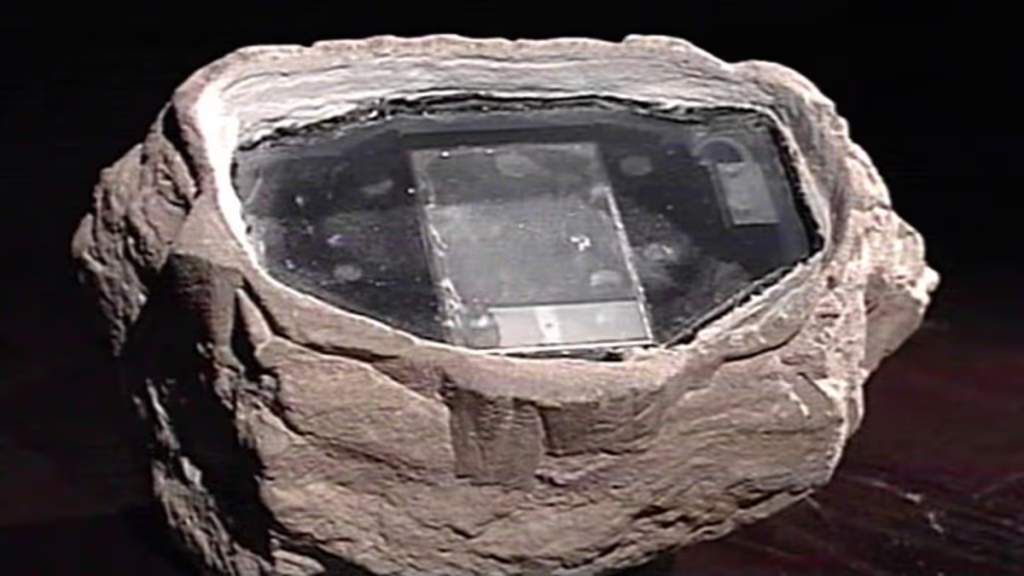
In 2006 the dead drop reached a new level of sophistication when British intelligence was caught using a fake rock in a Moscow park as an electronic dead drop. The rock contained an electronic receiver. British intelligence officers would pass within range of the rock with a handheld device that could wirelessly download data from the rock’s internal storage in seconds, without stopping or drawing attention. Russian agents with similarly equipped devices would upload intelligence to the rock without physically opening it. When the operation was exposed by Russian intelligence and eventually confirmed by Jonathan Powell, Tony Blair’s former chief of staff, it demonstrated that the core principle of the dead drop had survived the digital age completely intact.
Famous Cases
- Robert Hanssen
Robert Hanssen is the most extensively documented dead drop case in intelligence history, partly because his operational security was meticulous and partly because the FBI’s investigation of him produced an extraordinarily detailed affidavit describing exactly how the system worked.

Hanssen was an FBI counterintelligence agent who spent twenty-two years passing some of the most sensitive intelligence in American history to the KGB and its successor the SVR. He never met his handlers in person. He insisted on this from the beginning of his relationship with Russian intelligence and maintained it until his arrest. The dead drop was not merely a convenience for Hanssen. It was a foundational security principle that he believed, correctly, would protect him far longer than personal meetings ever could.
His primary dead drop location was beneath a footbridge in Foxstone Park in Vienna, Virginia. He would place packages there, leave a signal at a prearranged location, and collect money and communications left by his handlers using the same system in reverse.

The date coding system Hanssen used was a model of operational security thinking. Both sides agreed to add or subtract six from any stated date in written communications. A note suggesting a drop on September 9 meant March 3 in reality. An observer who intercepted the note without knowing the key would plan surveillance for entirely the wrong date.
Over his career Hanssen passed more than 6,000 pages of classified documents, 27 letters, 22 packages, and 26 computer disks. He received more than 1.4 million dollars in cash and diamonds in return. He was arrested in February 2001 at Foxstone Park while placing a package for his handlers, brought down partly through a source inside Russian intelligence who provided the FBI with a file that included Hanssen’s fingerprints.
Eric O’Neill, the FBI agent whose work was instrumental in catching Hanssen, described his subject to SPYSCAPE: “He loved it. It was the thing that made him feel like he belonged to something bigger than him. It was the thing that made him feel that he was the best at something in the world.”
2. Aldrich Ames
Aldrich Ames was a CIA case officer who began spying for the Soviet Union in 1985 and was not caught until 1994. His case is considered one of the most damaging intelligence breaches in CIA history, resulting in the identification and execution of at least ten CIA assets inside the Soviet Union.

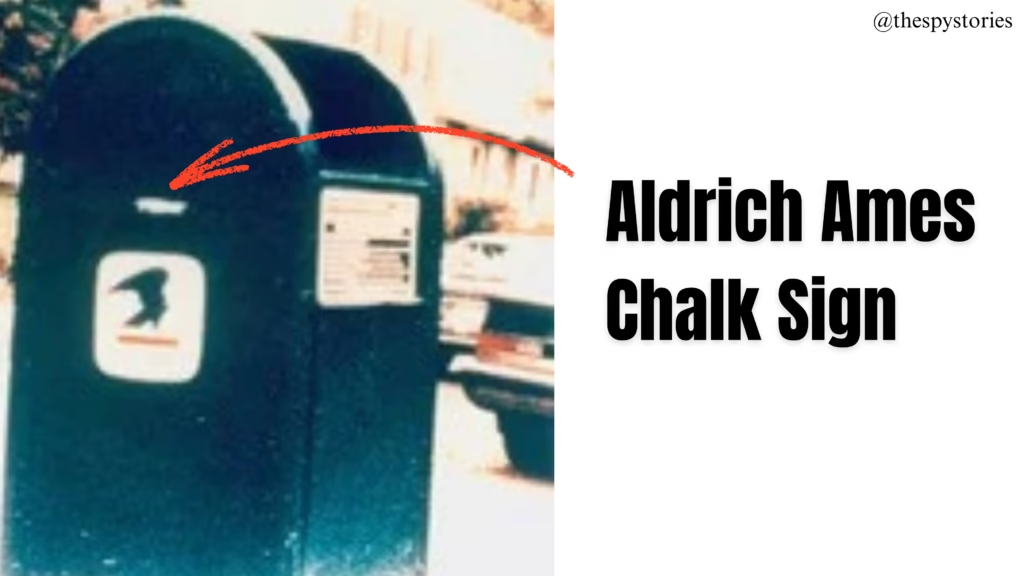
Ames used dead drops extensively throughout his career as a spy, though his operational security was considerably less disciplined than Hanssen’s. He communicated with his Soviet handlers using chalk marks on a mailbox near his home in northern Virginia to signal that he had made a drop or was ready to collect. The signals were simple: a chalk mark in a specific location meant a drop was ready, its absence meant the location was clear.
What made Ames particularly significant from a dead drop perspective is that his wife, Maria del Rosario Casas Dupuy, was directly involved in the operation. She helped manage communication with handlers and was involved in the logistics of the exchange system. She was convicted alongside her husband and sentenced to five years in prison. The Ames case demonstrated that the dead drop system is only as secure as the discipline of everyone who touches it.
3. Jonathan Toebbe
Jonathan Toebbe was a US Navy nuclear engineer with top-secret clearance who was arrested in 2021 after attempting to pass classified information about American nuclear warships to what he believed was a foreign intelligence service. His contact was in fact the FBI.
Toebbe’s chosen concealment method became one of the most widely reported dead drop stories in recent history. He concealed a flash memory card inside half a peanut butter sandwich and left it at a dead drop location in West Virginia while his wife Diana acted as lookout. He also used a chewing gum packet and a Band-Aid wrapper as concealment devices on other occasions.

What the Toebbe case illustrates is the enduring appeal of the dead drop method even in the age of digital communication. Toebbe was a sophisticated, educated professional with access to secure digital systems. He chose physical dead drops because he understood, at some level, that the physical exchange offered a layer of separation that digital communication could not.
4. Rudolf Abel
Rudolf Abel was a Soviet intelligence officer who operated in the United States from 1948 to 1957 under deep cover, and whose case gave the world one of the most famous concealment devices in dead drop history: the hollow nickel.
Abel used a specially hollowed-out coin to pass microfilm. The coin appeared completely normal in circulation, indistinguishable from any other five-cent piece, but its interior had been machined to create a cavity large enough to conceal a tiny roll of microfilm.
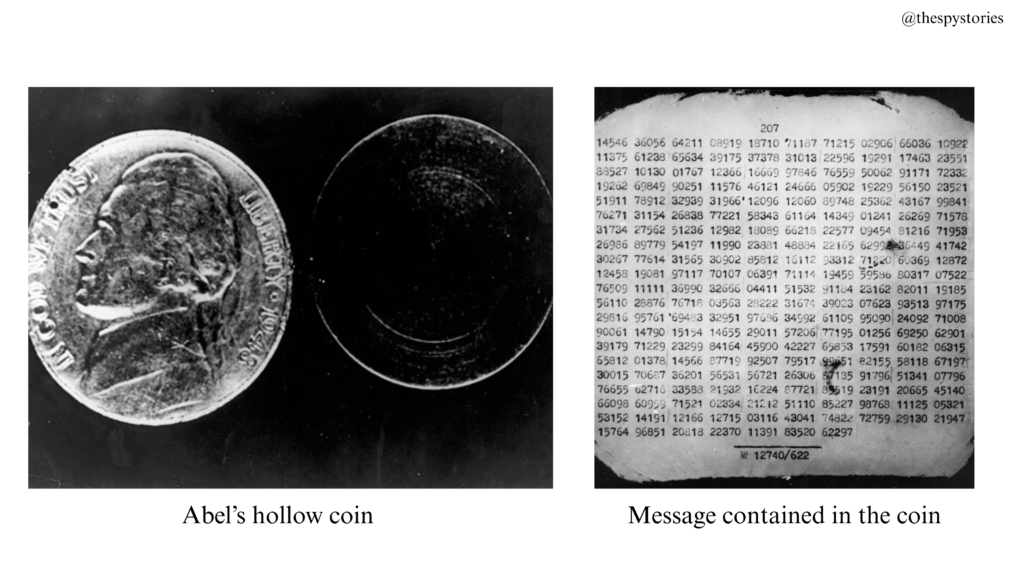
Abel was ultimately exposed not through any failure of his dead drop system but because one of his hollow nickels was accidentally passed to a newspaper boy as change. The boy noticed the coin was unusually light, eventually passed it to the FBI, and the subsequent investigation led to Abel’s arrest.
The hollow nickel is now on display at the International Spy Museum in Washington D.C. and remains one of the most elegant examples of concealment device engineering ever documented.
How the Signal System Works
The dead drop location is only one part of the system. The signal system is what makes the whole operation function, and understanding it is essential to understanding why dead drops work as well as they do.
The signal system exists to solve a specific problem. If a spy visits a dead drop location to collect a package that has not yet been left, they have made an unnecessary trip to a sensitive location for no operational gain. Worse, if they search a location that has been compromised and is under surveillance, they have exposed themselves for nothing. The signal system prevents this by communicating whether a drop has been made before the collecting party goes anywhere near the location.

A fill signal is left by the depositing party to indicate that a drop has been made and is ready for collection. This is typically something completely innocuous in a location separate from the drop itself: a chalk mark on a specific lamppost, a thumbtack pushed into a telephone pole, a piece of tape placed at a specific height on a park bench. The signal has to be something that any passing member of the public would walk past without a second thought, but that the collecting party knows to look for.
The collecting party checks the signal location first, before going anywhere near the dead drop. If the fill signal is present, they proceed to collect. If it is absent, they continue their normal routine and check again at the next prearranged opportunity.
After collection, the collecting party leaves a cleared signal at a separate location to confirm that the package has been successfully retrieved. This tells the depositing party that the drop was made and collected successfully, and that the system is functioning.
The genius of this three-location system is that it separates the signal from the drop from the confirmation. Surveillance of any one of the three locations gives investigators only one piece of a puzzle they cannot complete without the other two. Even if investigators identify the drop location, they may not know the signal location. Even if they identify the signal, they cannot determine who is leaving it or reading it without sustained covert surveillance of everyone who passes the signal point.
Types and Hiding Spots
Dead drop locations share certain common characteristics regardless of when or where they are used. The location must be accessible to both parties without requiring unusual behaviour. Visiting a park, a library, a public toilet, or a busy street is explainable. Accessing a restricted area is not. The location must offer enough concealment that the package is not likely to be accidentally discovered by a member of the public. And the location must be in surveillance dead space, away from cameras, guard posts, and high foot traffic areas that might record who visits and when.
Common dead drop locations across documented intelligence history include the hollow bases of park benches and lamp posts, the undersides of bridges and walkways, loose brickwork in public walls, knotted cavities in tree trunks, behind radiators and heating units in public buildings, and beneath specific tiles or paving stones in public spaces.
Concealment devices have ranged from the Soviet Spike and the hollow nickel to peanut butter sandwiches, Band-Aid wrappers, and fake rocks with electronic receivers. The common principle across all of them is that the concealment device must be able to survive in its environment, protect its contents, and be completely unremarkable to anyone who is not specifically looking for it.
The Psychology of Plausible Deniability
The dead drop is not just an operational tool. It is a psychological instrument, and understanding that dimension reveals why it has been so effective for so long.
Plausible deniability is the ability to credibly deny involvement in something because no direct evidence of that involvement exists. The dead drop is a machine for manufacturing plausible deniability. An agent who has never met their handler in person, never received a payment directly from foreign hands, and never been observed in a location that connects them to a foreign intelligence service has far more deniability than one who has.
This works in both directions. A handler who has never met their asset cannot describe them accurately under interrogation. An asset who has never seen their handler cannot identify them. The dead drop creates a relationship between two people that is mediated entirely through objects and locations, and objects and locations cannot be cross-examined.
There is also a profound psychological effect on the asset. The dead drop creates a sense of professional distance that makes the relationship feel less personal and therefore less dangerous. An asset who thinks of themselves as leaving packages in parks rather than meeting with foreign intelligence officers is maintaining a psychological distance from the full reality of what they are doing. Intelligence psychologists have noted that this distancing effect can make assets more productive and longer lasting, because they are less likely to be paralysed by the full weight of their situation.
From Rocks to Flash Drives
The evolution of dead drop technology over the past century tracks almost perfectly with the evolution of information storage technology.
In the early Cold War, dead drops carried paper documents, microfilm, and physical photographs. As the Cold War matured, they carried computer disks and digital storage media. By the end of the Cold War, they were carrying encrypted digital files on increasingly miniaturised storage devices. The fake Moscow rock of 2006 took this evolution a step further by eliminating physical contact with the container entirely, downloading data wirelessly while the operative walked past.
The USB dead drop represents a fascinating civilian evolution of the same concept. Beginning around 2010, artists and privacy advocates began cementing USB flash drives into the walls of public buildings in cities around the world, creating anonymous, publicly accessible data exchange points.
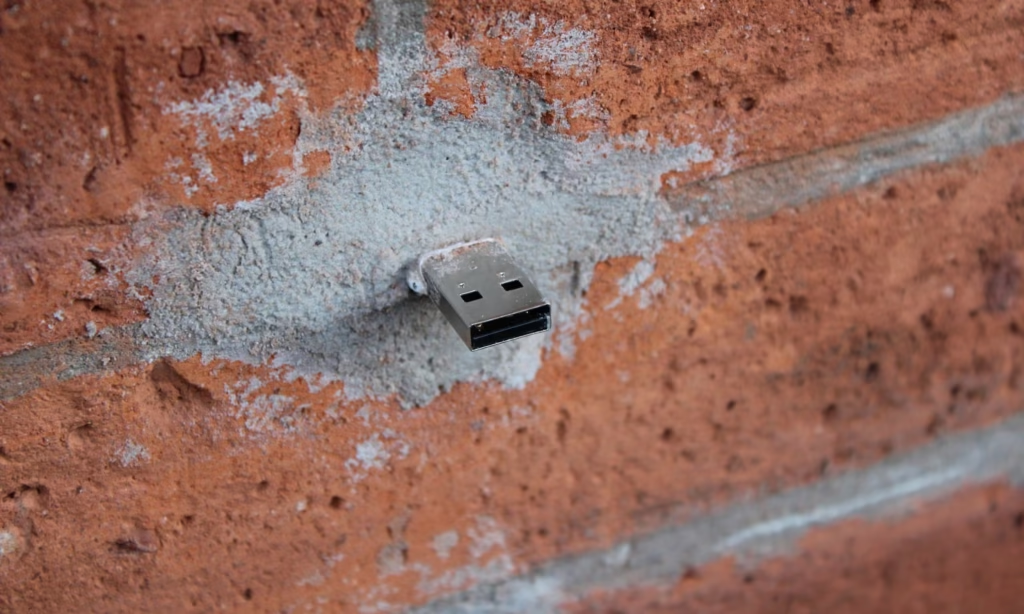
Anyone could walk up, plug in a device, and upload or download files with no account, no registration, and no record. The project, started by artist Aram Bartholl, was explicitly modelled on the intelligence dead drop concept and created a global network of physical anonymous data exchange points in plain sight.
Do They Still Work Today?
The honest answer is yes, but with important caveats.
Physical dead drops are harder to execute in modern urban environments than they were during the Cold War. CCTV coverage in most major cities is extensive. Facial recognition technology is increasingly deployed on public camera networks. Smartphones generate location data continuously. The surveillance environment that the Cold War dead drop was designed to defeat has become significantly more comprehensive.
However, the fundamental problem the dead drop solves has not changed. Two parties still need to exchange material without creating an observable direct connection. The dead drop still addresses this problem more effectively than any alternative. What has changed is the level of operational care required to execute it successfully.
Modern intelligence services have adapted the technique rather than abandoned it. Digital dead drops, encrypted communication platforms, and hybrid physical-digital methods have extended the concept into new domains. The core principle, separate the exchange from the people making it, remains as operationally sound as it was when Tsarist revolutionaries were leaving notes in St Petersburg doorways a century ago.
Robert Hanssen understood this better than almost anyone. For twenty-two years he insisted on dead drops over personal meetings, and for twenty-two years it worked. His eventual arrest came not from a failure of the dead drop system but from a human intelligence source inside Russian intelligence who provided his fingerprints.
Editor’s note: Some images in this article were generated using AI.