
Summary
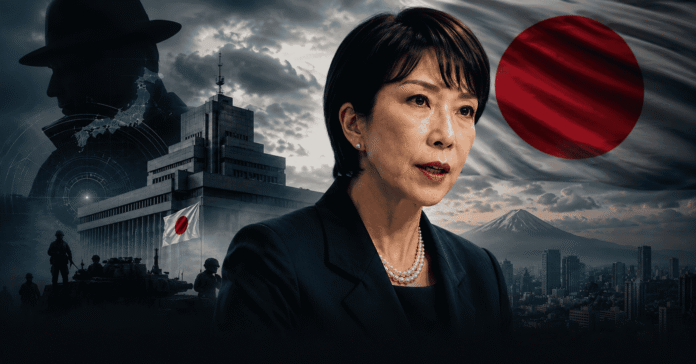
Japan has passed legislation to establish its first centralised intelligence agency since World War II, ending decades of deliberate intelligence restraint driven by the legacy of wartime authoritarianism.
What Happened
Japan’s National Diet passed legislation in May 2026 creating two new bodies: a National Intelligence Council to serve as the government’s central hub for intelligence gathering and analysis, and a separate operational agency. The reform transforms the existing Cabinet Intelligence and Research Office into these two institutions.
Prime Minister Sanae Takaichi, who took office in October 2025, described the law as “a first step” toward strengthening Japan’s espionage capabilities. The United States, Germany, and Australia are advising Tokyo on the agency’s construction. Japan has never had a foreign intelligence service, relying instead on American intelligence support since the end of World War II.

Why Japan Never Had a Spy Agency
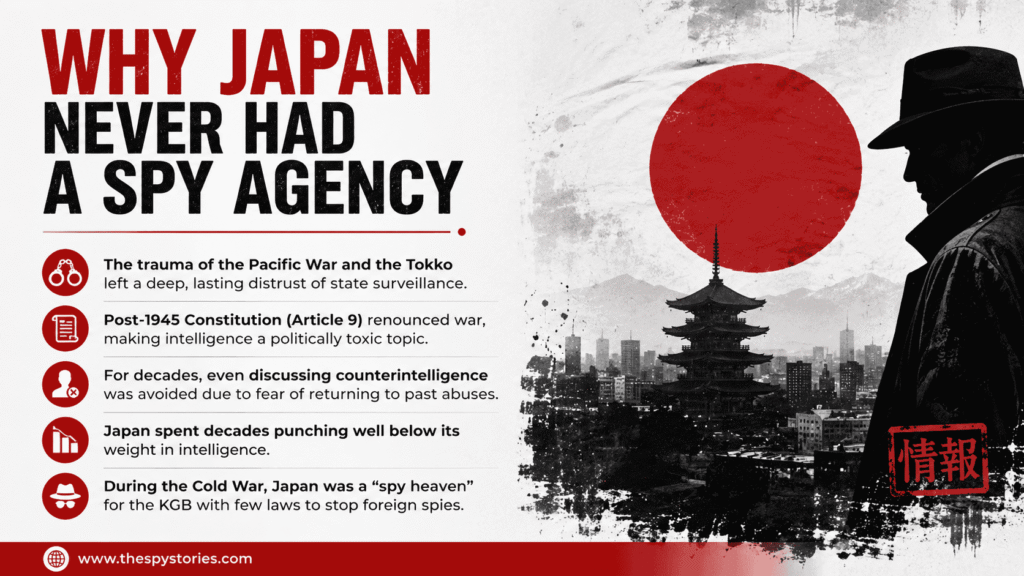
The answer lies directly in the trauma of the Pacific War. Japan’s wartime Special Higher Police, known as the Tokko, monitored, arrested, and tortured citizens for their political beliefs, leaving a deep and lasting distrust of state surveillance among the Japanese public. After defeat in 1945, Article 9 of Japan’s new constitution renounced war entirely, and intelligence became one of the most politically toxic subjects in the country.
For decades, even discussing counterintelligence was largely avoided. Japanese voters feared that any intelligence apparatus would put the country back on a slippery slope toward the domestic surveillance and control that had defined the military government. The consequences of that era were not a distant memory but a living one.
The result was that Japan spent decades punching well below its weight in intelligence. During the Cold War it was described, not unfairly, as a spy heaven. Soviet KGB officers had little difficulty cultivating Japanese politicians, journalists, academics, and even service members, operating in an environment where legal grounds to intercept or prosecute foreign intelligence operatives were almost nonexistent.
Why Japan Wants the Agency Now
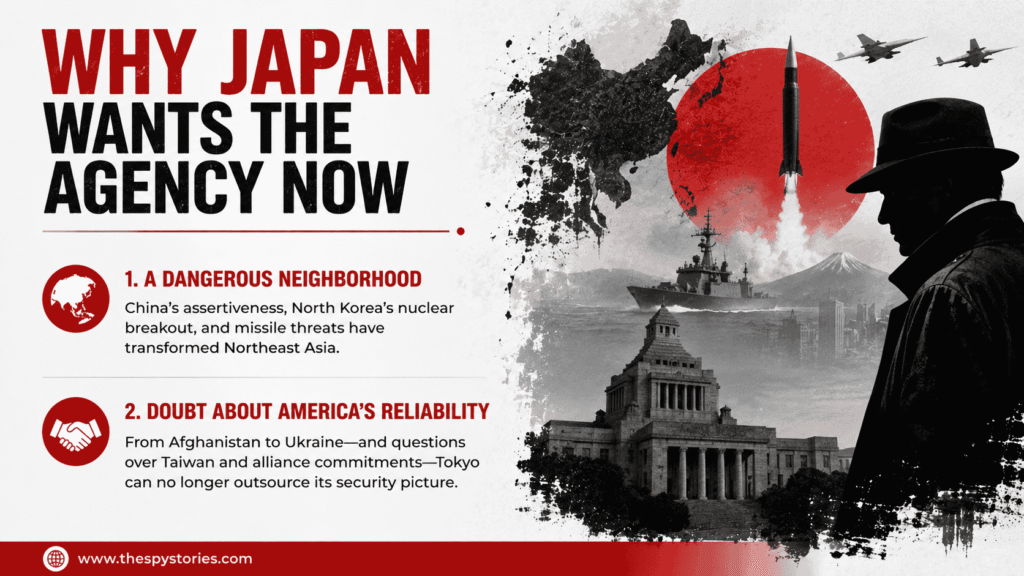
There are two distinct reasons driving this shift, and both reflect how dramatically Japan’s strategic environment has changed.
The first is the threat landscape in northeast Asia. China’s increasingly assertive behavior in the South China Sea, along its borders, and toward Taiwan has fundamentally altered the regional balance of power. North Korea has achieved nuclear breakout and continues testing missile capabilities in areas directly threatening Japanese territory. The strategic environment of 2026 is categorically different from the Cold War, and Japan’s existing intelligence architecture was built for a world that no longer exists.
The second reason is quietly more significant: growing doubt about American reliability. Japan watched the United States abandon Afghanistan in 2021. Six months later it watched Washington hesitate over how to respond to Russia’s invasion of Ukraine. Headlines across Japan asked the same question: is Taiwan next, and which country closer to Japan might the United States abandon? That anxiety, combined with President Trump’s repeated questioning of alliance commitments, has convinced Tokyo it can no longer afford to outsource its intelligence picture entirely to Washington.
Who Is Helping Japan Build The Agency
Japan is not building this institution alone. The United States, Germany, and Australia are actively advising the Japanese government on how to structure and establish the new agency, according to reporting by the New York Times. Experts note that the model Japan is developing will not be a direct copy of any existing agency, including the CIA.
Professor Ken Kotani of Nihon University tolf Al the National Intelligence Council and bureau model will be original to Japan, shaped by its own legal and constitutional constraints. The reform is likely to be designed to improve coordination, reduce barriers between agencies, and ensure intelligence products are better matched to what policymakers actually need.
What Comes Next
Japan has approved its largest-ever defence budget at $58 billion and is moving toward lifting its ban on lethal weapons exports, while also building a centralised intelligence agency. Taken together, these represent the most significant transformation of Japan’s security posture since the postwar settlement.
The new agency will place real constraints on how foreign intelligence services operate inside Japan, and that includes allies. Both the CIA and MI6 have long operated in an environment where Japanese law offered them considerable latitude. A functioning counterintelligence apparatus with proper legal tools will change that calculation for every foreign service, friend or adversary, operating on Japanese soil.
Like us on Facebook, follow us on Instagram and TikTok, and subscribe on YouTube for more stories from the world of espionage and OSINT.