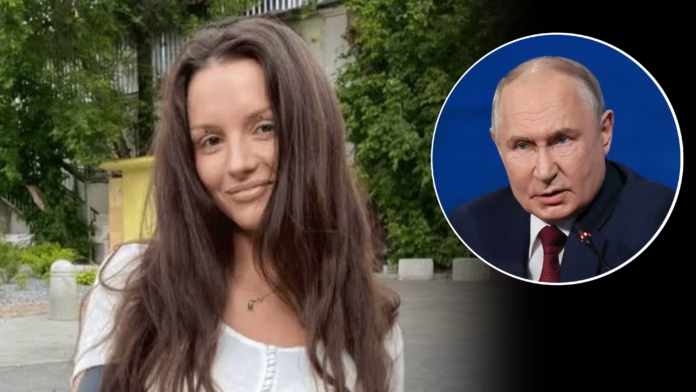
Rita Flores, a former member of the anti-Putin protest group Pussy Riot, says Russia’s FSB coerced her into becoming an informant, tasking her with spying on dissidents and helping orchestrate the elimination of an exiled former member of her own group.

What Is Pussy Riot
Pussy Riot is a Russian feminist protest collective known for provocative performances targeting Vladimir Putin and the Russian Orthodox Church. Founded in Moscow in 2011, the group became internationally known after several members were arrested and imprisoned for staging an unauthorized performance inside Moscow’s Cathedral of Christ the Saviour in 2012.
The group has consistently used art, music and public protest as political tools against the Kremlin. Its members have faced repeated persecution, raids, imprisonment and exile. Several prominent members now operate from outside Russia, making the collective a symbol of Russian political dissent abroad.

Why Did Rita Agree to Help the FSB
Flores did not agree willingly. FSB officers raided her Moscow apartment in February 2023 and immediately began applying pressure. They threatened her with criminal prosecution over social media posts about alleged Russian war crimes in Ukraine.
When legal threats alone were not enough, they escalated. “They began recruiting me with all kinds of threats and abuse, including threats to murder my family and that I would never be able to prove who killed my mother,” she told exiled news outlet Port.
She signed a cooperation agreement under that pressure, was given the codename Harley, and began receiving monthly payments of 50,000 rubles, around 600 dollars, from her handlers. She says she spent over two years deliberately sabotaging her assignments, faking personal feuds with targets to delay their arrest.
The Plot to Liquidate Her Ex-Boyfriend
In mid-2025 the FSB crossed a line Flores said she could not ignore. Her handlers ordered her to lure Pyotr Verzilov, her former boyfriend and a prominent exiled Pussy Riot member, to a cafe in Serbia. Undercover FSB agents would be waiting to kidnap and remove him. For her role in delivering him, Flores was offered 3 million rubles, approximately 36,000 dollars. She refused.
“That was the point of no return,” she said. “Before, I thought I just needed to wait to get my passport back and flee. But then I realized how far they were willing to go.” She stalled her handlers, sought help from human rights lawyer Dmitry Zakhvatov, and was eventually helped to flee Russia by exiled businessman Leonid Nevzlin earlier this month.

What This Tells Us About the FSB
Flores’s account, which The Moscow Times was unable to independently verify, fits a pattern that Western intelligence agencies have been tracking for years. The FSB does not only recruit career agents. It coerces ordinary citizens, artists, activists and dissidents into its network through threats, blackmail and financial inducement, turning people’s personal relationships into operational assets.
The elimination plot against Verzilov in Serbia is also consistent with Russia’s documented history of targeting exiles on foreign soil, from the poisoning of Sergei Skripal in the UK to multiple operations against dissidents across Europe. What makes this case notable is that the recruited asset refused, documented her experience, and made it public.
If you liked this story, follow The Spy Stories on Facebook, Instagram, and TikTok, and subscribe on YouTube for more from the world of espionage.